中國石油集團經濟技術研究院《石油天然氣行業報告》發布會
特首政策組組長致辭全文
2026年7月14日
特首政策組組長黃元山博士早前出席國家高端智庫中國石油集團經濟技術研究院 (Economics & Technology Research Institute, ETRI)《石油天然氣行業報告》發布會並致辭,分享在國家「十五五」規劃下,香港在國家能源發展中所擔當的角色。
以下為黃元山博士的致辭全文(只有英文):
Prof Li (Professor Li Cheng, Director of Centre on Contemporary China and the World, The University of Hong Kong), President Lu (Mr Lu Ruquan, President of Economics and Technology Research Institute of China National Petroleum Corporation), distinguished guests, ladies and gentlemen,
Good afternoon.
Opening: Hong Kong – Where China's Energy Story Meets the World
It is a privilege to stand before this gathering of energy leaders, researchers, and executives at what I believe is a genuinely significant moment.
ETRI's Oil & Gas Industry Report has been shaping energy policy conversations for 18 consecutive years. When you chose Hong Kong as your first overseas launch venue in 2024, you made a statement: that Hong Kong is not merely a financial centre – it is a thinking centre, a place where China's energy narrative engages the world on equal terms. Your return in 2026 deepens that commitment, and we are honoured to be your stage once again.
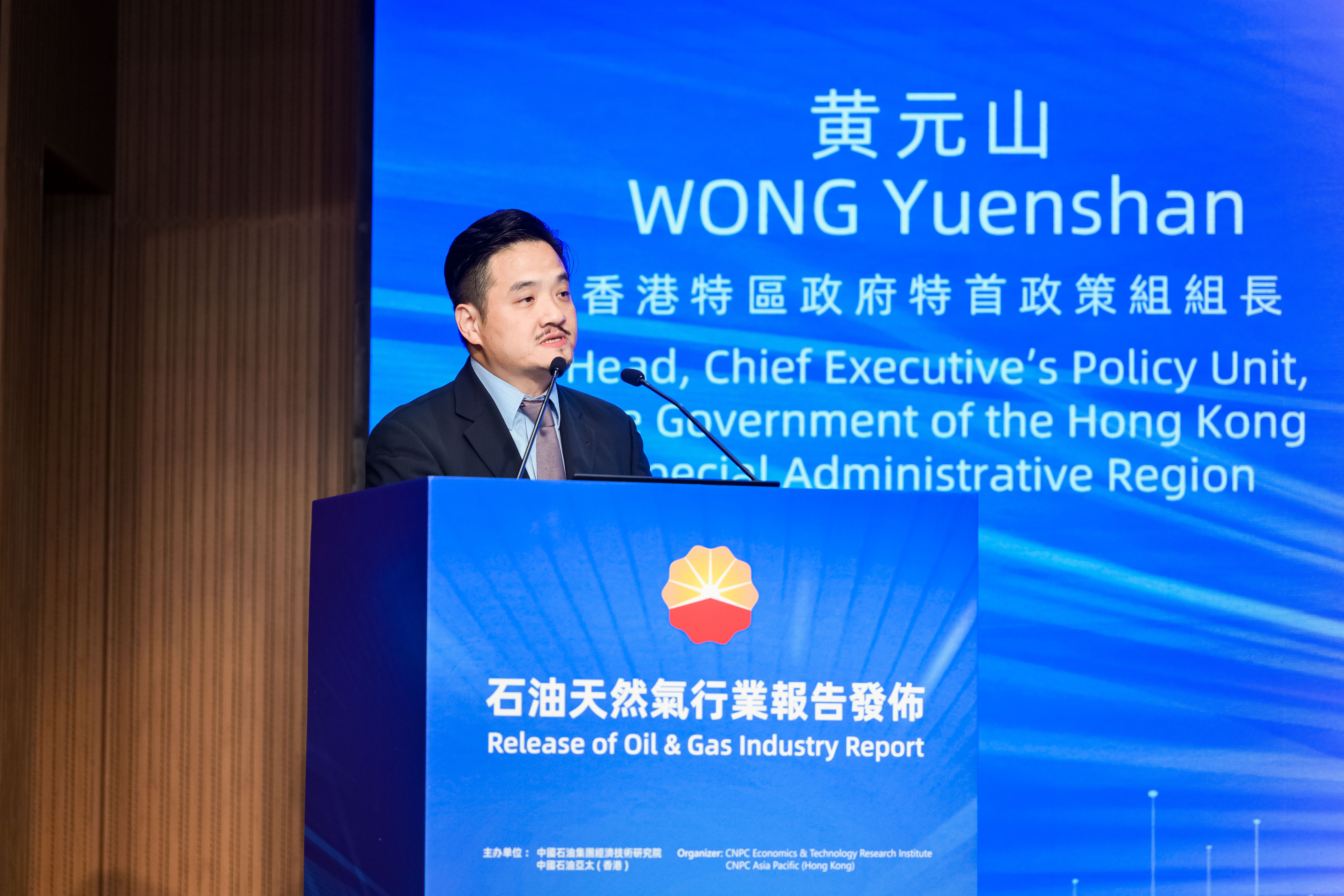 黃元山博士出席中國石油集團經濟技術研究院《石油天然氣行業報告》發布會。
The Chief Executive's Policy Unit, which I lead, conducts in-depth research on local and Mainland policies and developments as well as international trends. We also co-ordinate the preparation of Chief Executive's annual Policy Address, facilitating the turning of evidence into policy.
In this regard, for us, ETRI is not simply a research institute – it is a thought partner whose invaluable insights continuously inform our own work. I look forward, today, to a genuine exchange – not just of data, but of strategic vision.
The National 15th Five-Year Plan: China's Energy Ambition – and Hong Kong's Mandate
For the first time in our history, Hong Kong is crafting its own Five-Year Plan – aligning ourselves, more deliberately and more precisely than ever before, with the grand arc of national development.
The National 15th Five-Year Plan sets an audacious goal: to build China into an energy powerhouse – clean, low-carbon, safe, and efficient. It mandates the strengthening of energy supply security, including sustaining annual crude oil output at around 200 million tonnes, while simultaneously building the world's most ambitious renewable energy system. Our country is not choosing between energy security and the green transition, but insisting on both – simultaneously and at scale.
This dual imperative is not a contradiction – it is a strategic masterstroke. And it opens an enormous door for Hong Kong.
Hong Kong's role in China's energy future is not that of a spectator. We are not observers watching from the sidelines as the national energy system is remade. We are an active, indispensable participant – bringing green finance expertise, international legal standards, risk management infrastructure, and commodities trading capabilities that national energy enterprises increasingly need as they navigate a world defined by geopolitical complexity and accelerating energy transition.
This report – covering the full sweep of domestic and international oil and gas markets, from supply security to the green transition – could not arrive at a more opportune moment. It arrives as we write Hong Kong's own chapter in China's energy story.
On Commodities: Building the Trading Ecosystem China Needs
Hong Kong is open for energy business – and the country has said so
For the first time, the National 15th Five-Year Plan explicitly mandates the development of a commodity trading ecosystem in Hong Kong.
In fact, we began laying the groundwork in the 2024 Policy Address, exploring targeted support to attract commodity trading enterprises from the Mainland and internationally. In 2025, we moved from exploration to execution: introducing half-rate tax concessions for commodity traders establishing operations in Hong Kong, and establishing the Strategic Committee on Commodities under the leadership of the Financial Secretary – a high-level body with a clear mandate to make Hong Kong the region's premier commodities hub.
Energy commodities – oil, gas, and increasingly clean energy products – are not just strategic resources. They are the molecules and electrons that drive global pricing mechanisms, investment flows, and geopolitical leverage. A world-class commodities ecosystem in Hong Kong means that when energy is priced, hedged, financed, and traded in Asia, Hong Kong is at the centre of that conversation.
Our commodities agenda and our green transition agenda are, in fact, two sides of the same coin: one anchors our role in the energy markets of today; the other shapes the energy markets of tomorrow.
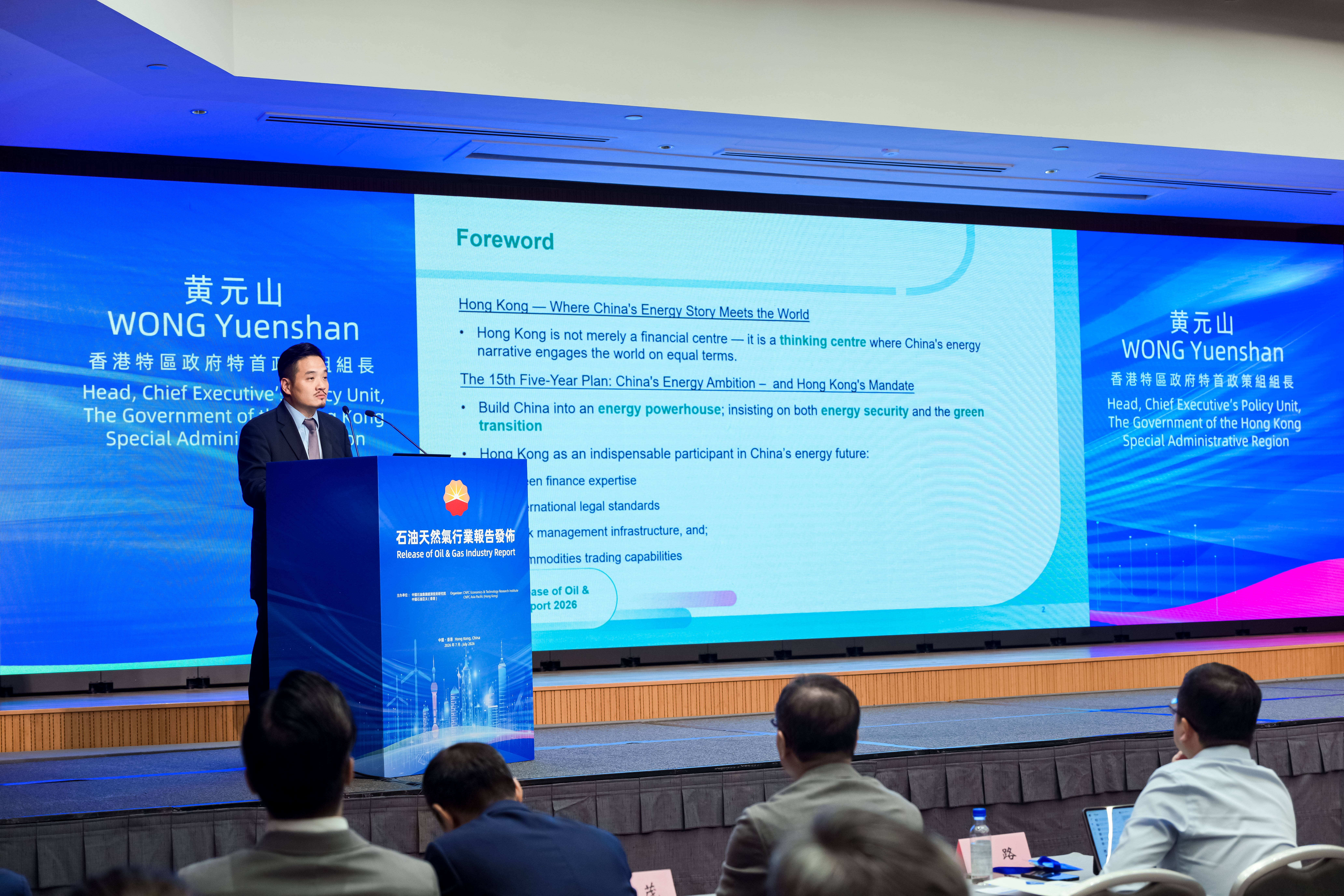 黃元山博士在中國石油集團經濟技術研究院《石油天然氣行業報告》發布會致辭。
On Green Transition: Three Proof Points, One Direction of Travel
Hong Kong's carbon neutrality goal – before 2050 – is ambitious. But ambition without action is rhetoric. What I want to share with you today are three concrete proof points that demonstrate we are not just setting targets – we are meeting them.
a. Sustainable Aviation Fuel – Flying Green from the Bay Area
Sustainable aviation fuel is widely recognised as one of the most impactful levers for decarbonising aviation – one of the hardest sectors to abate. Hong Kong is not waiting for the technology to mature. We are actively building the supply chain.
In early May, with the support of the Hong Kong Government, a local sustainable aviation fuel (SAF) supplier signed a landmark Memorandum of Understanding with the Dongguan Municipal Government to establish the first complete SAF supply chain in the Greater Bay Area (GBA). This is GBA integration in action: Hong Kong brings the standards and certification expertise, green finance architecture, carbon asset management, and international aviation demand. The GBA hinterland brings land and a reliable supply of feedstock. Together, we are building something neither could build alone.
b. Electric Vehicles – Numbers That Speak Louder Than Targets
In a city famous for its density, its harbour, and its skyline, something remarkable has happened quietly on our roads.
Electric vehicles now account for nearly one in four private cars on Hong Kong's streets – a penetration rate that surpasses both the United Kingdom and Singapore. In 2025 alone, three in four newly registered private cars were electric. Our charging network has expanded more than 2.5 times since 2021, with 130 000 charging-enabled parking spaces now woven into the city's fabric.
These are not projections. These are facts on the ground.
The policy framework behind these numbers includes a firm commitment to cease new registrations of fuel-propelled private cars by 2035 or earlier; first registration tax waivers for electric commercial vehicles, motorcycles, and tricycles; the systematic conversion of petrol filling stations into fast-charging or hybrid charging facilities and more.
For an audience that understands better than most how deeply embedded oil dependency is in the fabric of modern cities, Hong Kong's EV story is a living case study: that with the right policy architecture, even the most complex urban environments can transition – decisively, measurably, and fast.
c. Hydrogen – From Pilot to Corridor
Hydrogen is the frontier of Hong Kong's green transition. It is also, notably, one of the future industries explicitly identified in the National 15th Five-Year Plan.
We are not approaching hydrogen with caution. We are approaching it with conviction. The 2025 Policy Address committed to formulating hydrogen standard certification, establishing public hydrogen filling facilities on Hong Kong Island and in Kowloon, and – critically – developing a GBA Hydrogen Corridor in collaboration with Guangdong Province.
Through the New Energy Transport Fund, the Government has earmarked $100 million to subsidise companies trialling hydrogen fuel cell vehicles, filling infrastructure, and fuel costs. As of end-May 2026, 38 hydrogen trial projects have received agreement-in-principle – spanning transport, infrastructure, and power generation at construction sites.
We are not yet at the destination. But we are building the road.
Closing: Powering the Future, Together
Ladies and gentlemen, let me close with a thought that is both analytical and personal.
The choices made in the next five years – by governments, enterprises, and researchers like those in this room – will shape the energy architecture of the next fifty. As data centres and digital infrastructure drive exponential demand for clean electricity, energy transition is no longer just an environmental imperative. It is a competitive imperative. Economies that lead the green transition will lead the AI era.
Aligned with China's dual carbon goals, backed by world-class financial infrastructure and the full weight of national support, Hong Kong is uniquely positioned to bridge China's energy ambitions and the world's capital markets. By launching this report in Hong Kong, year after year, ETRI is affirming something important: that Hong Kong is where China's energy future is debated, shaped, and shared with the world.
Thank you – and I wish this event every success.