Closing remarks by Head of CEPU
at 2026 Colloquium on International Law
7 July 2026
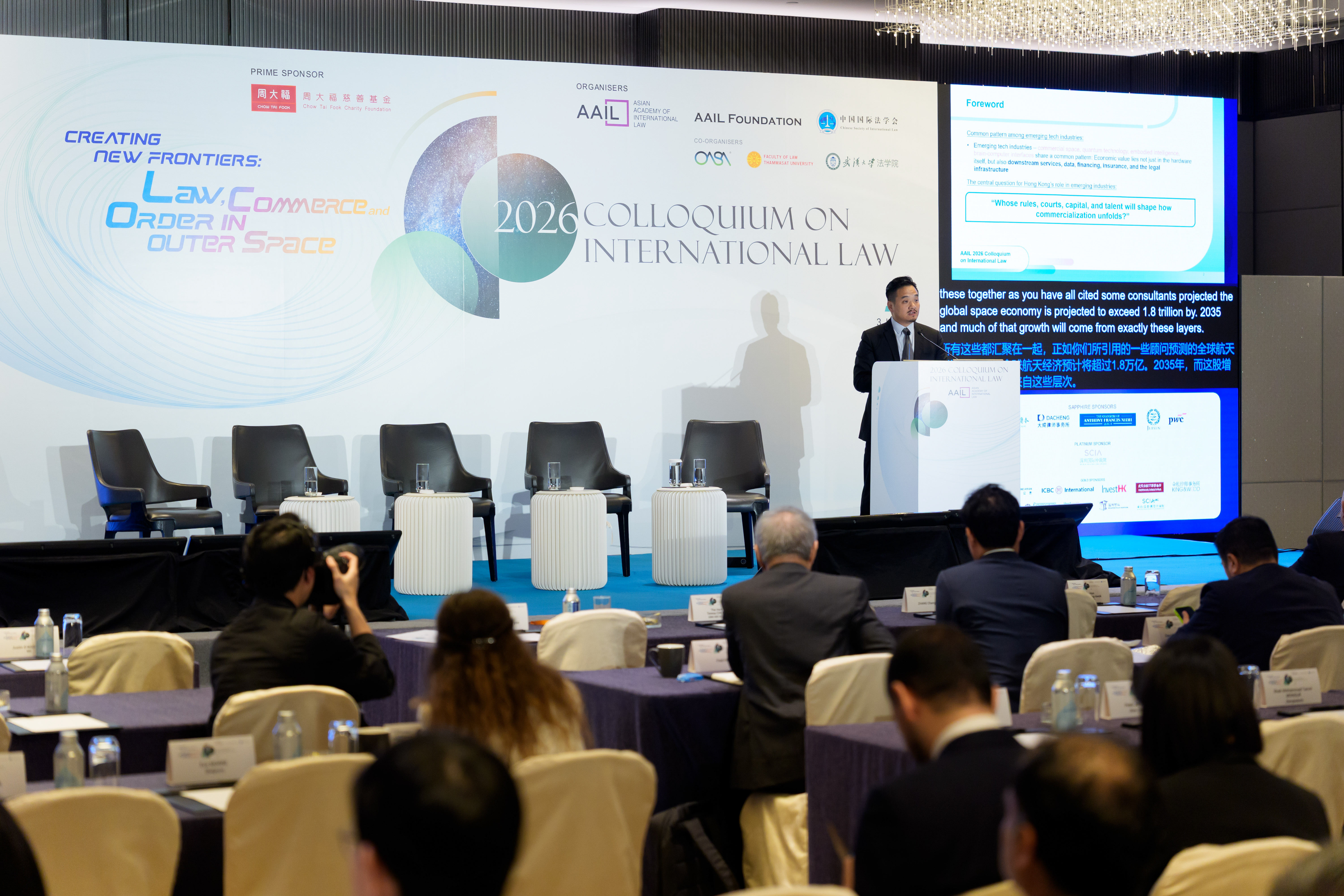
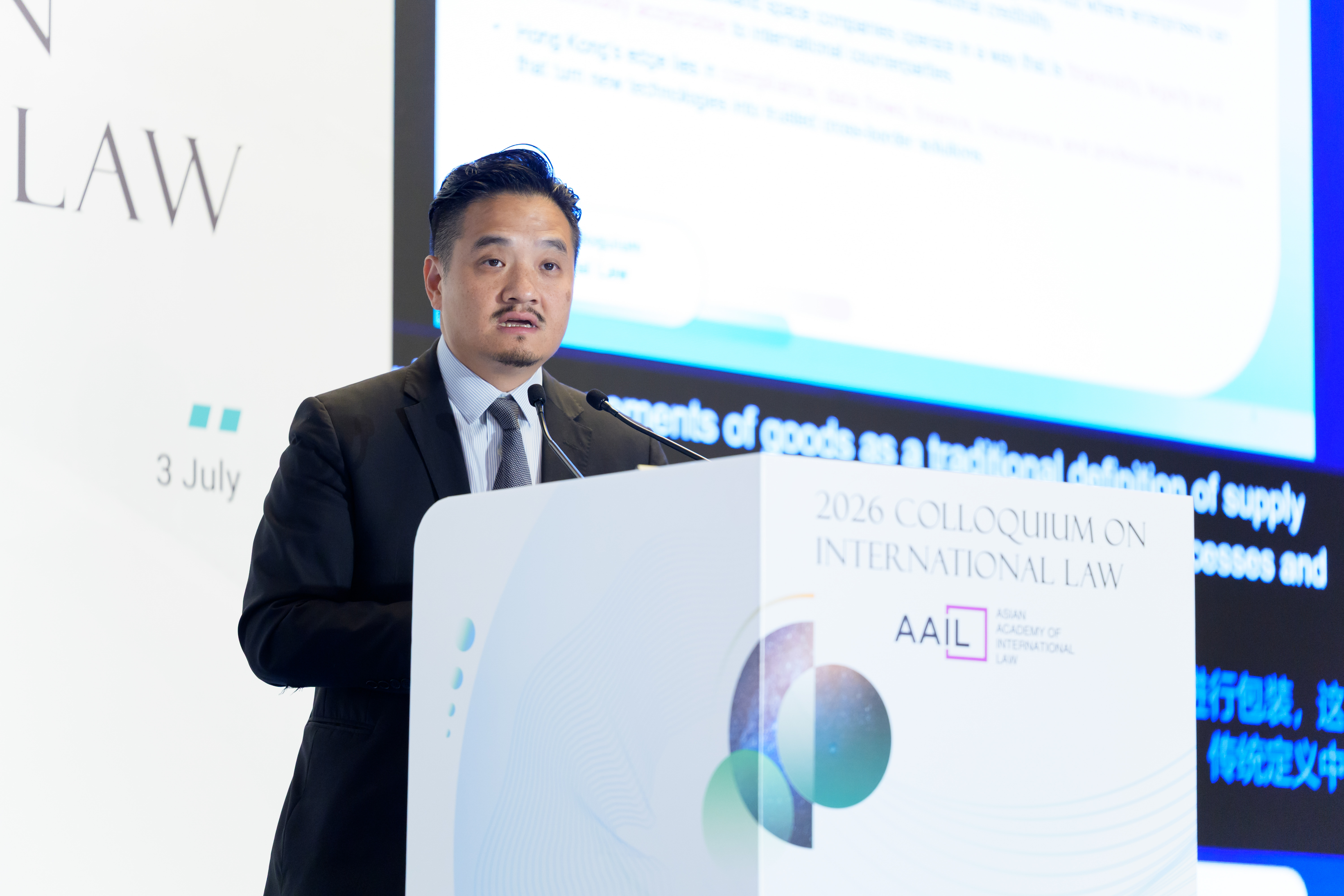
Dr Stephen Wong, Head of the Chief Executive's Policy Unit (CEPU), earlier attended the 2026 Colloquium on International Law, organised by the Asian Academy of International Law (AAIL), the AAIL Foundation, and the Chinese Society of International Law, and delivered the closing remarks. Under the theme “Creating New Frontiers: Law, Commerce and Order in Outer Space”, the colloquium explored how Hong Kong can leverage its robust financial markets, common law system, and strengths in its professional services to align proactively with the National 15th Five-Year Plan, and promote the development of the aerospace industry.
Following is the speech by Dr Wong:
Anthony (Dr Anthony Neoh, Chairman of Asian Academy of International Law), distinguished guests, ladies and gentlemen,
Good evening.
May I begin by thanking the Asian Academy of International Law, the AAIL Foundation, and the Chinese Society of International Law for convening today's colloquium, and for bringing this conversation to Hong Kong.
|
|
| Dr Stephen Wong attended the 2026 Colloquium on International Law. | |
The emerging tech industries of this century share a common pattern. Whether we are talking about commercial space, quantum technology, embodied intelligence, brain-computer interface – the economic value increasingly lies not just in the hardware itself, but in what surrounds it: downstream services, data, financing, insurance, and the legal infrastructure that holds it all together. Some consultants projected that the global space economy alone is projected to exceed USD 1.8 trillion by 2035, and much of that growth will come from exactly these layers.
And economies, as we know, run on rules.
So the question before us is whose rules, whose courts, whose capital, and whose talent will shape how that commercialisation unfolds – and how the international legal order adapts to govern frontiers that no existing framework was designed to address. That is the question this seminar has been wrestling with all day.
i. Hong Kong's Role in Supporting the development of a modernised industrial system
Here, allow me to offer some reflections from a policy research perspective. Our work in this area is still in progress – these industries are developing, the questions are open, and our understanding keeps evolving.
As we look across these cutting‑edge technology markets, two features stand out and, in our view, help to explain where the opportunity for Hong Kong may lie.
On governance, today we are looking into brand-new markets like commercial space. Global benchmarks and international standards for them either do not yet exist or are still being contested.
And yet, as today's seminar has demonstrated so well that the methodology for governing them is the same as it has always been: you need a full international framework – rules and regulations, governance structures, and international collaboration. Whether the domain is commercial space, brain-computer interface, quantum technology or embodied intelligence, the playbook has the same pattern. The international community is still writing the rules, and that is precisely where the opportunity lies.
On internationalisation, for Chinese enterprises are operating at the frontier of these new technologies, the same questions arise:
How do they engage international markets? How do they navigate unfamiliar regulatory environments, access international capital, and manage cross-border risk and legal exposure?
These are not questions unique to space. They arise wherever Chinese tech innovation meets the international system.
ii. Three Roles, Three Capabilities
And that is where Hong Kong's existing strengths become relevant. The National 15th Five-Year Plan has assigned Hong Kong several distinct roles in this broader national strategy. These centres are not just labels; they describe concrete capabilities that Hong Kong has already built, and which new technologies and new markets now give us the opportunity to deepen.
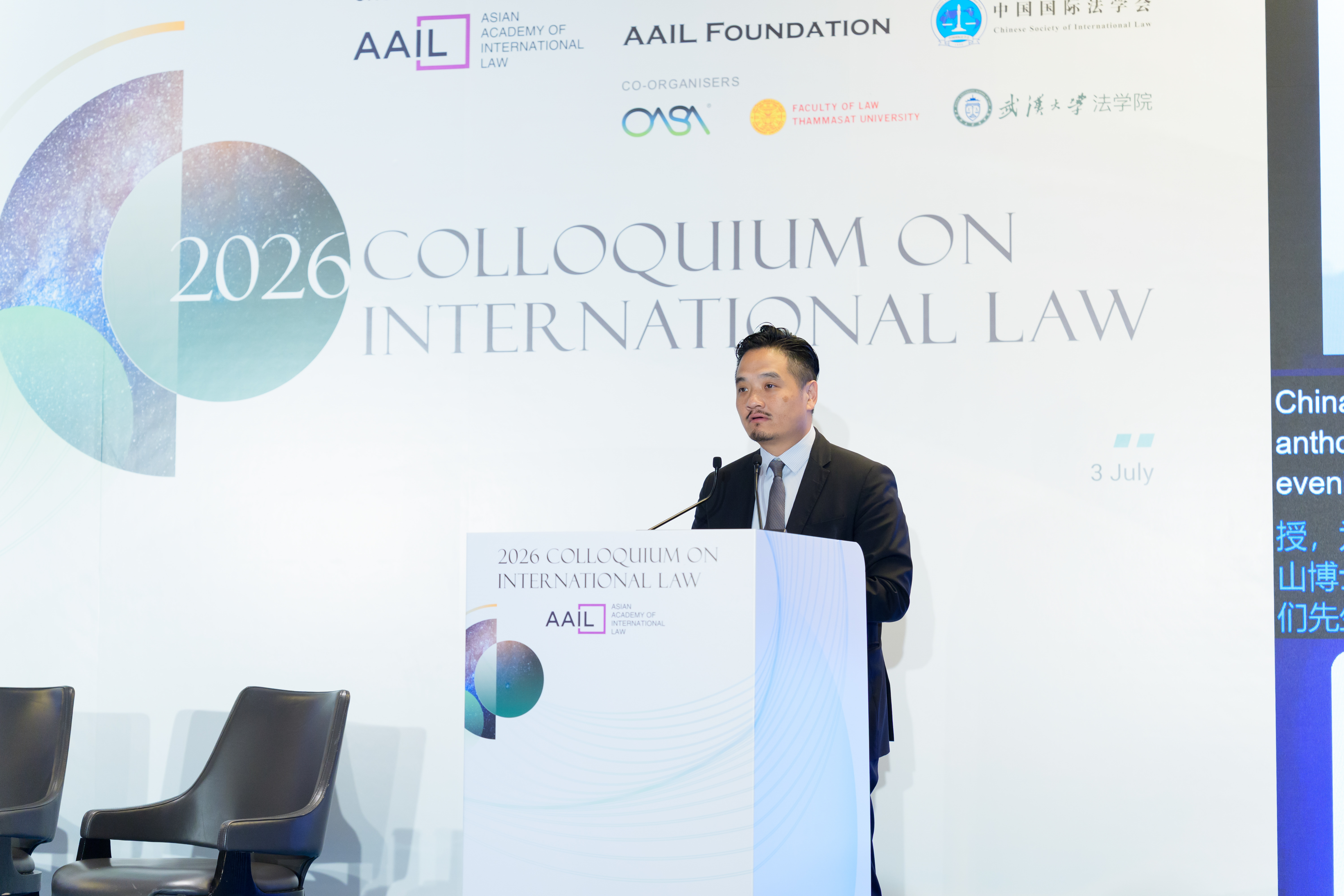 Dr Stephen Wong delivered his closing remarks at the 2026 Colloquium on International Law.
First, the High Value-Added Supply Chain Centre (高增值供應鏈中心).
For emerging tech industries where global supply chains are still being built, Hong Kong's role as a trusted, internationally-connected trade and logistics hub provides a platform through which Chinese enterprises can source, structure, and move across borders with international credibility.
In space, we see this in how the Two Hong Kong-headquartered high-orbit satellite operators – backed with Mainland capital but operating to international commercial standards – have for decades served as the market-facing interface between Chinese space resources and global demand. They show, in practice, how a high value-added supply chain centre like Hong Kong can operate: not only moving capacity across borders, but packaging it in a way that is financially, legally and operationally acceptable to international counterparties.
As these industries grow more complex, the “supply chain” in question is no longer just physical movement of goods; it increasingly includes data flows, compliance processes, and integrated professional services. That is precisely where Hong Kong's strengths as a high value‑added supply chain centre can potentially be further brought to bear – helping to turn new technologies into trusted, cross‑border solutions that the international market can recognise and work with.
Second, the International Legal and Dispute Resolution Services Centre in the Asia-Pacific region (國際法律及爭議解決服務中心).
For any new market, the absence of established global benchmarks means that commercial contracts and arbitral awards effectively become the de facto rules of the industry.
For emerging tech industries that do not yet have settled international legal frameworks, Hong Kong's common-law system and arbitration infrastructure are directly relevant.
Whether the issue is orbital slots and spectrum interference in commercial space, IP and data in quantum technologies, or liability and safety standards in embodied intelligence, Hong Kong can help shape the emerging international rulebook – not only by providing a venue for dispute resolution, but also by contributing to the design and testing of contractual and regulatory frameworks against international practice.
Third, the International Risk Management Centre (國際風險管理中心).
Brand-new markets carry brand-new risks. Whether it is orbital debris liability in space, or product liability in embodied intelligence, the international insurance and reinsurance frameworks to manage these risks are still being established. Hong Kong's deep professional base in insurance, actuarial science, and risk management – and our track record in building specialty risk pools, as with the marine specialty risk pool established in 2025 – positions us to contribute to this standard-setting process.
As emerging industries scale, they will require not only traditional lines of insurance, but also highly tailored coverage for launch risk, in‑orbit operations, cyber‑physical systems, data and algorithmic behaviour. That is precisely where an international risk management centre can add value: by helping to translate new technologies into insurable, bankable risk structures that international markets can recognise and price.
Throughout our numerous research study trips and stakeholder meetings in this space, the picture that has emerged, in my reading, is one of continuity rather than a completely new mandate: Hong Kong would be applying capabilities it has long developed – across law, finance, insurance, and professional services – to a new set of frontiers, be it in commercial space, brain-computer interface, quantum technology, or embodied intelligence, and in doing so to further strengthen its three centres' roles under the national plan.
iii. Where This Leaves Us
I want to close with a note of genuine modesty, because it is warranted.
The commercial space economy is a genuinely new domain. The legal frameworks are still being negotiated. The market structures are still taking shape. The relevant regulatory questions – from orbital debris liability to cross-border spectrum coordination to the enforcement of commercial space contracts across jurisdictions – are questions that no single city, and no single government, can answer on its own.
What I have described today is a work in progress. We are at an early stage of understanding what this domain might mean for Hong Kong, and we are proceeding with appropriate care.
What I am confident about is this: these questions deserve continued, serious, high-level discussion – exactly the kind of discussion that today's seminar has provided. The diversity of expertise assembled in this room – international lawyers, satellite operators, academics, regulators, and the policy community – is precisely what is needed to make sense of a frontier this complex.
Hong Kong is beginning to carve out its role in these emerging tech industries, and that role will be refined through continued dialogue and practical experience – including seminars and conferences like the one we have had today.
So may I close by thanking, once again, the organisers and co-organisers, together with every panellist, moderator, and participant who has contributed to today's dynamic conversation.
Thank you very much. I wish you a most enjoyable dinner.